3D Modeling and Animation Techniques with Cinema 4D
A course by Federico Piccirillo, 3D Motion Designer

Joined August 2021

Learn innovative techniques for modeling and animating 3D sculptures to make a Memphis-style GIF
Joined August 2021

Designing in 3D means taking advantage of the depth in digital space to create believable compositions that simultaneously stretch the limits of reality. It allows you to unleash your imagination and bring otherwise impossible ideas to life in just a few clicks. For Federico Piccirillo, 3D motion designer who has worked with clients like Nike, Nissan, Apple, OPPO, and more, this is the beauty of working in more than two dimensions: nothing is off limits.
In this course, he teaches you the 3D animation and modeling techniques he's learned throughout his career, as well as some tricks he's picked up along the way. Learn how to model a sculpture out of colorful, geometric shapes and animate it using Cinema 4D. By the end, you'll know how to create an animated GIF from start to finish, transforming a simple idea into a final render to share on social media.
What will you learn in this online course?
25 lessons & 20 downloads
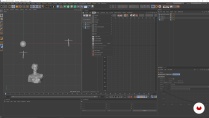
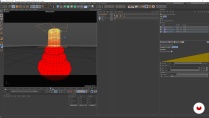
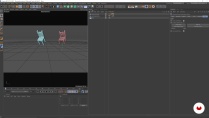
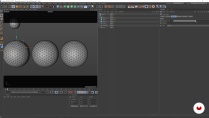
What's included in this course?
Get to know your teacher Federico Piccirillo as he talks through his artistic career and the experiences that led him to become a 3D motion designer. See the wide variety of references that inspire his work, from advertising, art, and museums to animated feature films.
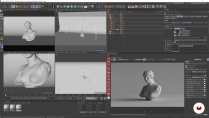
Next, look at the tools Federico uses to animate in Cinema 4D and discover how to combine several techniques and improve your workflow. Learn how to create a Soft Body simulation as well as build a versatile and realistic lighting set-up.
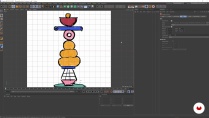
Now it's time to work on your final project. Federico teaches you how to model your sculpture before putting it in motion. Draw a sketch, put together a storyboard, and choose the colors and materials for your objects.
Once you've shaped your model, move on to animating it across multiple shots. Learn how to use Adobe Premiere to edit your sequence and integrate seamless transitions.
Polish secondary animations, double check lighting and materials, and create a high-quality render of your work. Then import your project into After Effects for the post-production phase. Do some final retouching and color correction on your render before exporting it to share on social media.
- 98% positive reviews (66)
- 2,458 students
- 25 lessons (4h 38m)
- 20 additional resources (2 files)
- Online and at your own pace
- Available on the app
- Audio: Italian
- Italian · Spanish · English · Portuguese · German · French · Polish · Dutch · Turkish · Romanian · Indonesian
- Level: Intermediate
- Unlimited access forever
Recommended software & tools for this course
 Adobe After Effects
 Cinema 4D
 Redshift Render
What is this course's project?
Create an animated GIF of a colorful, geometric sculpture in Cinema 4D.

Projects by course students


Who is this online course for?
Anyone who wants to hone their animation skills in Cinema 4D.
Requirements and materials
A working knowledge of both Cinema 4D and Redshift is required for this course. You also need a computer with the software installed, as well as programs like Redshift, Adobe Premiere, and After Effects, although these can be substituted by other equivalent programs.

New to Adobe After Effects? In that case, we recommend taking Domestika Basics courses to learn how to use the software: Introduction to After Effects.
Reviews

Federico Piccirillo
A course by Federico Piccirillo
Federico Piccirillo is a 3D motion designer with a long-standing passion for design, film, and photography. He studied graphic design and visual communication at the University of Florence, and later specialized in digital and 3D illustration.
After graduating, he spent three years working as a motion designer at a studio in Turin before making the leap to freelancer. Throughout his career, he's collaborated with clients like Nike, Apple, Google, AT&T, OPPO, and more.
Content
-
U1
Introduction
-
Presentation
-
Reference models
-
-
U2
The Tools to Create Animation
-
Interface and Animation Curves
-
Dynamics, Vertex Weight and Alembics
-
How to Save Simulations
-
Simulating a Soft Body with Deformers
-
Organizing a Realistic Light Set
-
-
U3
Modeling the Sculpture
-
Sketch and Storyboard
-
Object Manager, Shot and Light Set
-
Apply Colors and Materials
-
Continuing to Model
-
Rendering a Still Frame
-
-
U4
Animation in Cinema 4D
-
Organizing the Work
-
Animation of the Cones
-
Soft Body
-
Alembics, Camera Framing and Animation
-
Rendering of the Playblast
-
Animating the Second Shot
-
Camera and Framing
-
-
U5
Retouching and Editing in Adobe Premiere Pro
-
Work on Secondary Animations
-
Basic Rules for Smooth Transitions
-
Review Lights and Materials
-
Render Settings and Final Rendering
-
Working in After Effects
-
Color Correction and Conversion
-
-
FP
Final project
-
3D Modeling and Animation Techniques with Cinema 4D
-
What to expect from a Domestika course
-
Learn at your own pace
Enjoy learning from home without a set schedule and with an easy-to-follow method. You set your own pace.
-
Learn from the best professionals
Learn valuable methods and techniques explained by top experts in the creative sector.
-
Meet expert teachers
Each expert teaches what they do best, with clear guidelines, true passion, and professional insight in every lesson.
-
Certificates
PlusIf you're a Plus member, get a custom certificate signed by your teacher for every course. Share it on your portfolio, social media, or wherever you like.
-
Get front-row seats
Videos of the highest quality, so you don't miss a single detail. With unlimited access, you can watch them as many times as you need to perfect your technique.
-
Share knowledge and ideas
Ask questions, request feedback, or offer solutions. Share your learning experience with other students in the community who are as passionate about creativity as you are.
-
Connect with a global creative community
The community is home to millions of people from around the world who are curious and passionate about exploring and expressing their creativity.
-
Watch professionally produced courses
Domestika curates its teacher roster and produces every course in-house to ensure a high-quality online learning experience.
FAQs
The course is designed for users with basic to intermediate knowledge of Cinema 4D. You don’t need to be an expert, but it helps to be familiar with the software’s interface and main functions.
To follow the course, you’ll need Cinema 4D, Redshift as the rendering engine, Adobe Photoshop for digital sketches, and After Effects for post-production. A computer with good graphics power is recommended.
You’ll learn how to model, animate, and light 3D scenes in the Memphis style, manage storyboards and creative workflows, use advanced soft body and Redshift techniques, and export animations ready for GIFs and video.
The course covers animating geometric shapes, managing timelines and curves, using markers, soft body dynamics, smooth transitions, and advanced animations with fields and deformers in Cinema 4D.
Yes, the course includes lessons on creating storyboards, paper sketches, and planning pre-production—essential for structuring every animated project.
Yes, the course dedicates time to advanced lighting with Redshift, covering dome lights, area lights, managing Global Illumination, and optimizing render settings.
During the course, you’ll learn how to apply soft body tags, use fields and random fields, manage parameters like gravity, stiffness, and cache, and optimize simulations using Alembic.
 Adobe After Effects
 Cinema 4D
 Redshift Render
Es un buen curso, te enseña técnicas nuevas y el paso a paso de cómo hacer el proyecto.
Great course!
one of the best 3d designers out there
Es un buen curso, te enseña nuevas herramientas y sus usos. Lo recomiendo para artistas que ya tengan conocimientos de cinema 4D.
El curso es muy interesante, va directo al punto y es perfecto para un artista con nociones básicas de Cinema4D, lo que lo hace perfecto si ya has tomado otro de los cursos de Domestika sobre el manejo básico de esta herramienta. El profesor es muy claro y la información muy útil.